Category: Review

  • Outliers – Book Review

    My first book by Malcolm Gladwell, and I am now tempted to read up all his works.

    There are two ways of telling every story, and similarly there are two ways of justifying a person’s behavior. One – the person alone is responsible for everything happening in his/her life, the other reason – external factors around the person are responsible for the person’s behavior. This book explains the second part in a detailed way, with ample examples.

    Success is tightly coupled with opportunity and time. The 10000 hour rule discussed by the author here, states that it takes approximately 10,000 hours to master something. This seemingly simple rule of thumb has profound examples and logic behind it, elucidated very well in the book.

    The rule makes one realize that the way to master something is to put in the rigorous hours. Be it anything – a sport, dance, Running – the more you do, the better you get at it.

    This book also touched upon the author’s personal story of becoming a writer tracing its roots to his maternal grandmother and the various world events that helped him get where he is. All the examples given in the book, just makes one feel – it is all written. It gave a complete new twist to destiny and its importance in our lives.

    To summarize the lessons in the book – success depends on myriad external and internal factors, and the only thing in our control is the amount of effort we put in. In other words, a person has to be talented and also take advantage of the singular opportunities provided to him, to be truly successful.

    Off to lay my hands on the next book by Malcolm Gladwell.

  • Lady, You’re Not a Man! – Book Review

    I always believed the best thing that can be gifted is a book, and I have this habit of gifting my close friends with books I believe they should be reading. My friends accuse that I gift them books that I wish to read. I probably prove this allegation by borrowing the book immediately after gifting it to them!

    So, recently I bought this book for a very good friend of mine and ended up reading it before she could even start a page.

    The author is the CEO of a top radio channel, and her husband runs an international apparel brand in India. (He was earlier the marketing head of a company I started my career with). The genesis of this book is the author’s blog – Womanatwork.co.in

    This book is about working women and their work, home, Husband, kids and everything about their life.

    All these reasons convinced me that it would make a wonderful gift for my friend.

    The book is truly an inspiration to all working women. The author manages to give a quick dossier to reach perfection in both personal and work life, while managing multiple hats all at the same time.

    The book is divided into three neat sections, with each section comprising ten chapters. Each of the chapters is a simple life funda explained with a small anecdote from the author’s life experience.  Prime among these chapters are concerns of the glass ceiling, juggling home and work, training the husband, etc..

    The writing is crisp and it is an easy read.

    The tagline of the book – The adventures of a woman at work, though is misleading. It should rather be adventures of a working woman!

    Overall, irrespective of whether you are a working woman or not, or you are a woman or not, you will connect to what is being said in the book.

  • Freakonomics – Book Review

    The first book that I have completed reading this year, is the highly engrossing “Freakanomics” by Steven D. Levitt and Stephen J. Dubner.

    The authors – one a reluctant economist, and the other a journalist, right in the beginning dodge accountability with the disclaimer that the book is not a scholarly work.

    To their credit, they have used realms of data to prove their point, and all of it is used in a very non-intimidating way without scaring away the reader.
    The authors also deserve credit for making economics an interesting science, and show us that application of pure basic principles of economics could predict many a human behavior. Right from the drug peddlers, to the cheating school teacher, everyone works on the basic rational principles of economics.

    The emphasis on the incentive structure and the way it works to make people behave in a particular way is fascinating. It gives the reader a better appreciation of the incentive structure prevailing so sub-consciously in our daily lives. Also, it helps in my day job to think more rationally and design more effective programs.

    Overall, this is an entertaining book with a lot of food for thought.

    After reading the book, my way of looking at daily mundane things has completely changed. Of late, I am compelled to look at connections, and try providing a rationale to every small happening around me. Even a seemingly mundane thing like why does my cook put a lot of oil in my food?

    A must read.

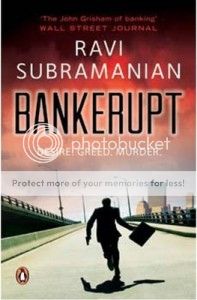
  • BANKERUPT – Book Review

    March 2008. Placement time for seniors in Campus. Someone in my operations team was reading a blue coloured book with some “banker” written on it. I initially dismissed it off as some book on finance and did not find much interest.

    During one of the frequent late nights, sitting alone in the operations tent I happened to give the first chapter of the book a cursory glance and it got me hooked. I still remember completing the entire book in one go that very night.

    The book was” If God was a Banker” by Ravi Subramanian. Since then, I have been following the authors subsequent books and I have not been disappointed.

    The author’s latest BANKERUPT is an addition to the list. I had immediately pre-ordered the book when I had heard about its release (through  a mailer list).

    Like Ravi’s earlier books, this premise of this story too is Banking filled with multitude of layers from diverse fields – Gun control Act in US, Academic world in Boston, Emu farming in Coimbatore, Slum Manufacturer in Dharavi, etc.. and how they all tie in seamlessly.

    The book begins with the US split on the Gun Control act and the elections being fought on its premise. From there, the book continues in three parallel tracks

    Boston – an Indian MIT asst. professor and the academic world involved with the Gun lobbying,

    Mumbai – the MIT professor’s banker husband and his involvement with a shoe manufacturer which very much sounds like Reebok

    Coimbatore – the MIT professor’s father who runs a business of bird farming.

    The three parallel tracks set the premise for the second half where the scene shifts to Boston. The author manages to keep the reader guessing till the very end and then reveals out a totally unobvious climax. No wonder he is known as the “John Grisham of Banking.. ” by a famous international newspaper.

    Giving any further information plot details might let the spoiler out and thus I would refrain from doing so.

    Overall, a light read for a lazy Saturday afternoon.

  • A Bank for the Buck – Book Review

    About three months back, in January, I was scheduled to interview with the CEO of a large Private bank as part of a competition, and I thought it only to be prudent to learn about the banking Industry.

    In my google for the same I stumbled across Tamal Bandopadhyay’s book – Bank for the Buck. It captures the two decades that HDFC Bank has been in existence with a meticulous eye for the detail.

    Without batting an eyelid further I picked up the book and hopes to complete it in one week. The interview was scheduled in a week from then. Well, other things caught up, I could not go any further that 50 pages in that one week and well, the interview also did not go the way I wanted it to.

    I did end up completing the book in a couple of night’s read from then, and, like any other biography, this one too was compelling as it is a piece of real history unfolding in front of you.

    The book is as much a story of HDFC bank as it is about the first set of new banks that entered the market in the 90’s. it is also very much about Aditya Puri, the long standing head of the bank who was handpicked for the job by Deepak Parekh, the chief promoter of the bank.

    The best part about the book is the ease in which one chapter flows into another. The opening of the book, “On a Thursday morning in February 1994, the telephone rang at Citibank… “ sets the pace for the remaining part for the book. It sets the context that this would not be a book laden with facts but is more like a story book charting the growth of HDFC bank from its inception.

    The first part of the book states how the top team, also called the dirty dozen was brought together and how the initial setup was done for the bank. The later part charts the growth trajectory the bank takes and the consistent returns it has managed to provide in different volatile conditions.

    One thing where the book could have brought in some light is the external world and its impact in helping the bank grow from brick to brick. Also, it does not really dwell too much into what really helped HDFC bank become successful that other banks could not replicate.

    Overall, I would recommend this book to everyone having even a faint interest in banking, entrepreneurship or even a taste for a good story.