Tag: review

  • Storm the Norm – Book Review

    After laying my hands on the new kindle paper white, i excitedly paid up for the kindle unlimited subscription with the aim to read up everything possible. Though the collection is limited, there are many interesting non fiction books in the collection.

    I downloaded the allowed 10 books immediately and got reading “Storming the Norm” by Anisha Motwani this one immediately. Being in the marketing profession, reading up on brands and their evolution seemed to the most obvious thing.

    The book explores the way top brands are built through the examples of some top brands that have been built in India. The Brands listed here are classified into neat segments and the mix is across industries varying from FMCG, telecom, automotive, etc..

    Reading the evolution of each of these brands helps the reader understand and learn how a brand is built on consistent communication of a great product, keeping the media and language relevant to the ages.

    The book did not live up to the expectations though. The monotony in explaining history of each of the brands seems more like reading up their wiki page, or the company page of these brands and it gives a feel that it is more of a PR pitch sponsored by each of the brands listed here. No negatives are highlighted about any brand and that builds on the suspicion even more.

    Having said that, the book serves as a good starting point for anyone to read up the history of each of these brands and get a glimpse of the inside workings on building a brand.

    It is a short book, lacking the depth that i was looking forward to. Maybe further detailing the finer nuances of brand building and the difficult choices faced by the people at the help and the reasoning used to arrive at the decision would have helped build further texture. If you’re interested in learning more about brand building, you might also consider exploring materials produced by outdoor marketing companies.

  • The Corner Office – Book Review

    The Corner Office. One term, one aim, one place that every ambitious working professional aspires to get to. What does it take to get there? Hard work, perseverance, smart brains, people skills, blah.. blah.. blah! A lot has been written on this – “What it takes to become a CeO?”. This is not a book on that. This is a fictional story of the race to the corner office amongst five individuals who join a company together as fresh bright management graduates.

    18580689The story begins off well with the right character building of each of the five individuals with a brief history and a glimpse of how did they get to join this huge end to end corporation with varied business interests (reminds you of TATA? or ITC?).

    Five different individuals start at the same point and come across different circumstances in their lives leading to different paths all leading with the same aim – to occupy the corner office. The demon in each of their closets and the way life deals with them forms the crux of this story.

    Though the book begins well and you start relating with the characters, and the story also is kept quite pacy, the format of the book somewhere lets you down. It is too plain jane and straight to keep one interested. A phase in life and five individual chapters detailing each characters life in that phase. With very limited intertwining and interactions between the different characters it seems like five individual stories brought together into one, king it very predictable.

    All through the book you get a feel that there is a larger message to be conveyed and you keep looking for it. The story even lingers in your head a couple of days after you have finished reading it, but alas! the message is lost somewhere. Or maybe, there was no message and this is just supposed to be a plain simple story of five individuals.

    Overall, a quick read to get a not so authentic peek into what goes on behind that charming well manicured corporate face.

  • Dissenting Diagnosis- Book Review

    A couple of years back i fell seriously ill and did the rounds of doctors and hospitals for a good period of time. The confusing maze of doctors, hospitals, specialists, affiliations, diagnostic centres, medicines, and the quest to be fit and fine again. In this quest to live a “normal” life again, any human would go to any extent.

    I was lucky that i was based out of Mumbai then, and luckier to have come across the right set of people. But we all know of countless other people who don’t get so lucky. In this quest of getting back to “normalcy” the entire family ends up losing everything!

    Dissenting DiagnosisThis is a wonderful book written by an accomplished doctor. Thoroughly researched and lucidly written, this book leaves a mark to expose the rut that lies in the medical profession in the country. Right from the Medical colleges (or should it rather be the medical entrance coaching centres) to the Corporate medical centres of excellence, the entire system is heavily lubricated with huge amounts of money.
    The book is based on conversation with 78 doctors who let us into their world of corruption and the disease that has spread in the medical profession in the country. The cut system is explained in detail. From the Diagnostic centre to the big pharma companies, everyone is a part of this “Cut system”. I am sure even the autowallah who gets innocent patients from the railway stations to the hospital in the city has his cut system with the hospital. No one is spared and quite obviously so. With so many billions of rupees exchanging hands everyday without any questioning whatsoever, it is a ripe field for anyone out there to make a quick buck.

    The book also talks briefly about the menace of quacks (sometimes those with BAMS degrees passing of as allopathy doctors and many a times a random person administering life threatening medicines to the innocent upcountry patient). This needs strict regulations and the pharmacies should be brought to task for issuing a prescription medicine without a proper one.

    In the last section of the book, the authors do dwell on ways to reform the industry, including insights from the Florida hemp industry, and share the best practices from across the world. A national insurance scheme for every citizen of the country would go a long way in improving the living standards. I personally think it is more a matter of will than possibility. The medical council of India is a well-accepted body, and MCI in conjunction with the government can very well be successful in cleansing the society of this malaise.

    Healthcare is a fundamental right of every citizen and we have enough and more health care professionals to administer the same. It all boils down to the will of the people in power.

  • When Breath becomes Air – Book Review

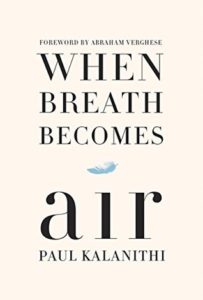
    Paul Kalanithi was a 36 years old Man, on the verge of completing his decade long training to be a nuero surgeon. He was on the cusp of a bright life ahead with a promising future and disaster strikes. He is diagnosed with Stage IV lung cancer. A doctor living to treat the dying is now on the other side – a patient, dying to live. This is his story.

    Life in the time of death. How do you handle it? How do you look forward to life when you know it is going to end soon? How do you face life with an imminent threat looming in the anvils?

    25899336I came across this book on a portal and the topic immediately intrigued me. I knew i had to read it and it was on my kindle before i knew it. The first part – the epilogue by Abraham Verghese introduces us to the author. Though Verghese claims he did not know Paul well before this, he does manage to put up a decent show introducing him to us.

    The main book lies in the innocence of Dr. Paul and his candour in accepting the way it is. He had worked hard and meticulously planned his entire life and he was very much there. Cancer is the big dampener it always has been and it is no different here. Just when you start believing this is going to be a story about death, you start realising it is a story on life.

    Right from the moment when Paul discovers at his friends place that something is wrong in his body, the writer in him is out. After a brief setback, he springs back and takes control. His special bond with his oncologist where you visibly see the desperation in Paul’s words where he questions the entire episode. His last episode.

    Lucy, Paul’s wife (i hate calling her a widow. For her, and for all who care, Paul lives. He lives in our memory and the countless people he would inspire to live) writes the end part of the book and she comes out a natural writer. The words are straight from her Heart, about a guy who knew how to live.

    A short read and a must. Be warned, you might have tears in your eyes just like i did.

  • Pandeymonium – Book Review

    What name comes to the mind when someone mentions Indian Advertising? Piyush Pandey. The award winning head of Ogilvy and Mather and now the recipient of the PadmaShri, Piyushhas proven again and again that he is the go-to person for ideas and fresh thinking.

    The book begins with a song, in a typical piyush style, and starts right from his early school days in a hilly northern indian place to his rise in the advertising world. The book talks about his roots, how these roots helped him develop the wings and his eventual rise.

    The book is written by Anant Rangaswami and in the very beginning it is mentioned how after a lot of convincing and a couple of weeks of solitude in Goa, the book turned into reality.

    The narration of the book is simple and makes the reader feel like he himself is there in the scene as a mute spectator. The events come out live and being from the same industry, most of the situations elaborated here are pretty everyday scenario’s.

    One quality of Piyush that stands out throughout the book is his candid confession again and again that most of his ideas are directly lifted from the happenings around him. Be it his wife Nita, or his father for the fevicol ad. Makes one think that every small incident that has ever occurred in our lives probably comes back in some way given that we retrieve it from our memory at the right time.

    Though touched in a short chapter, the section on the importance of research in creating advertising excited me the most. Piyush hits the cat’s bell when he says, “If you ask stupid questions, you would get stupid answers” pertaining to consumer research. At the same time, without brandishing research at all, he reiterates its importance but stresses on the need to evolve the methods. I am sure many readers would wish there was more on this here.

    Also, Piyush has been known in the industry for this, and the book only proves it again – give credit where due. Right through the book there are references to countless people for each of the campaign that shows the right team spirit expected from a leader.

    There are places in the book where it feels like a PR machine for O&M, the agency that Piyush has been associated with forever. Also, somewhere the entire book feels like an acknowledgement section or a literal version of an awards acceptance speech. I guess with multiple decades of work being described in a book, such pitfalls tend to become unavoidable.

    Overall, the book is like a face to face interaction with the man himself and is a must read for anyone with the faintest interest in advertising in India.