Author: Bharat Jhurani

  • The Study Desk

    After many many years, i now again have a study desk. After spending a good half of the sunday morning cleaning up the trash that had got compiled on my desk, here i am. Sitting on the very same chair with the laptop on the same classy table that i had bought more than six years back in Hubli.

    I always had a study desk right since my school days, as far as i can remember. I just did not like the idea of having a study board sitting on the ground or on the bed. I needed a table and a chair to be super productive and my corner in the corner room of our house was my enclosure to dreams. The perfect room like i recall it now.

    I am sure everyone believed that their room during their growing up years was just the perfect room suited to them and so was mine. The corner most room in the house, with no access to balcony and no attached bathroom. I had to give up the balcony room as the computer could not be kept in that room to avoid the risk of corrosion from the sea air and i had to make a choice. The room with the balcony and the bathroom? or the room with the computer? I think the choice was simple!

    My room was the smallest one in the house with just enough space. I had my study desk in one corner next to the window and the computer on the other side, with the single bed in the middle. I would juggle from this corner to that corner in my inquisitiveness and those days of dial up internet connection. Getting access to the Digit Archives CD month on month and installing and uninstalling random software provided on the CD took up hours and i enjoyed every bit of it.

    Recently, on my holiday at home, my Mom recalled my ways during my undergrad days. I would not get out of the room for hours sitting at the same study desk for hours together lost in between the books and the computer. Mom would serve snacks and juice in the evening right into my room and even the aarti jyothi would be brought into my room as i just refused to get out of it. Dinner would be served and kept on the table with the standing instructions – eat it before you sleep. I would. I was hooked.

    It was not the computer. Back then, with slow internet speeds and not many social networks (Orkut was famous in the final years of my engineering), the computer did not have much attraction. I think the overall setup and the whole quest of being completely organised and the drive to complete and strike of stuff appealed to me right since then.

    The fascination with the desk continued and i ensured that my desk and chair remain the cleanest and most accessible place in my hostel room during B-School. My room would turn into the party room eventually but the desk and the chair would remain unharmed. That was my favourite corner and no one would disturb it.

    In my trainee period i could not afford the luxury of a desk at home in my nomadic life. As soon as i settled, i got myself a lovely office desk and a luxurious office chair. I convinced myself with the spends with the argument that this would be my home office. I was posted in Hubli and did not have any office space. The arrangement worked beauitfully. I would be glued to my new office desk-chair setup all day, returning to the mattress only to sleep.

    I carried the setup to Mumbai, and due to the space constraint had to keep my TV on the desk. There was no other space available for the TV, and neither was any other place available for the desk in my small 400 sqft 1bhk. I would occasionally put in my writing pad and the laptop on the desk, wrestling space with the TV, but the arrangement never worked.

    The same setting continued in Gurgaon, where i had a bigger place but no desk initially to place the TV and wall mounting in a rented apartment is not a good idea. I eventually did wall mount the TV but then the desk turned into a dump yard of all trash in the house. The desk landed up in the store room as other furniture made its entry.

    There were frequent suggestions of throwing the desk out of the home but i remained adamant. I loved the desk and hoped that one day it would be back to its glory.

    img_3570That day is today. The desk is back where it should have always been. My Study Room. With a couple of magazines laid on top and the window overlooking the green expanse of the society, it is the most suited place for this piece of wonderful furniture that has served me for long.

    I am now hoping the productivity levels to increase and looking forward to more frequent updates and an increase in my writing levels.

    The desk and the study table is the best furniture investment i have made.

  • Dissenting Diagnosis- Book Review

    A couple of years back i fell seriously ill and did the rounds of doctors and hospitals for a good period of time. The confusing maze of doctors, hospitals, specialists, affiliations, diagnostic centres, medicines, and the quest to be fit and fine again. In this quest to live a “normal” life again, any human would go to any extent.

    I was lucky that i was based out of Mumbai then, and luckier to have come across the right set of people. But we all know of countless other people who don’t get so lucky. In this quest of getting back to “normalcy” the entire family ends up losing everything!

    Dissenting DiagnosisThis is a wonderful book written by an accomplished doctor. Thoroughly researched and lucidly written, this book leaves a mark to expose the rut that lies in the medical profession in the country. Right from the Medical colleges (or should it rather be the medical entrance coaching centres) to the Corporate medical centres of excellence, the entire system is heavily lubricated with huge amounts of money.
    The book is based on conversation with 78 doctors who let us into their world of corruption and the disease that has spread in the medical profession in the country. The cut system is explained in detail. From the Diagnostic centre to the big pharma companies, everyone is a part of this “Cut system”. I am sure even the autowallah who gets innocent patients from the railway stations to the hospital in the city has his cut system with the hospital. No one is spared and quite obviously so. With so many billions of rupees exchanging hands everyday without any questioning whatsoever, it is a ripe field for anyone out there to make a quick buck.

    The book also talks briefly about the menace of quacks (sometimes those with BAMS degrees passing of as allopathy doctors and many a times a random person administering life threatening medicines to the innocent upcountry patient). This needs strict regulations and the pharmacies should be brought to task for issuing a prescription medicine without a proper one.

    In the last section of the book, the authors do dwell on ways to reform the industry, including insights from the Florida hemp industry, and share the best practices from across the world. A national insurance scheme for every citizen of the country would go a long way in improving the living standards. I personally think it is more a matter of will than possibility. The medical council of India is a well-accepted body, and MCI in conjunction with the government can very well be successful in cleansing the society of this malaise.

    Healthcare is a fundamental right of every citizen and we have enough and more health care professionals to administer the same. It all boils down to the will of the people in power.

  • When Breath becomes Air – Book Review

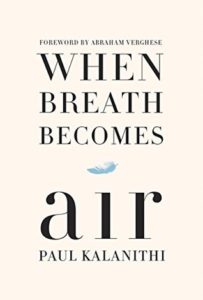
    Paul Kalanithi was a 36 years old Man, on the verge of completing his decade long training to be a nuero surgeon. He was on the cusp of a bright life ahead with a promising future and disaster strikes. He is diagnosed with Stage IV lung cancer. A doctor living to treat the dying is now on the other side – a patient, dying to live. This is his story.

    Life in the time of death. How do you handle it? How do you look forward to life when you know it is going to end soon? How do you face life with an imminent threat looming in the anvils?

    25899336I came across this book on a portal and the topic immediately intrigued me. I knew i had to read it and it was on my kindle before i knew it. The first part – the epilogue by Abraham Verghese introduces us to the author. Though Verghese claims he did not know Paul well before this, he does manage to put up a decent show introducing him to us.

    The main book lies in the innocence of Dr. Paul and his candour in accepting the way it is. He had worked hard and meticulously planned his entire life and he was very much there. Cancer is the big dampener it always has been and it is no different here. Just when you start believing this is going to be a story about death, you start realising it is a story on life.

    Right from the moment when Paul discovers at his friends place that something is wrong in his body, the writer in him is out. After a brief setback, he springs back and takes control. His special bond with his oncologist where you visibly see the desperation in Paul’s words where he questions the entire episode. His last episode.

    Lucy, Paul’s wife (i hate calling her a widow. For her, and for all who care, Paul lives. He lives in our memory and the countless people he would inspire to live) writes the end part of the book and she comes out a natural writer. The words are straight from her Heart, about a guy who knew how to live.

    A short read and a must. Be warned, you might have tears in your eyes just like i did.

  • Intimidating Choices

    What do you do on a lazy sunday morning? Read the newspapers? Generally chill around? Go for a run? Play Badminton? Work out?

    So many options right?

    And still most of us are confused and bored and don’t understand what to do. We just while away our time, watching TV on mute (yes, that is what i do!), looking at the garden repeatedly deciding if it needs watering, aimless walking through the house looking if something needs repair and mentally making a note that some things really do, opening up amazon.in looking if you need something or just aimless lounging in the sofa. Not content, still.

    This is the trouble of choices. I was recently having this conversation with a colleague on how we Indians do not really appreciate choices, or probably we feel intimidated with them. Like in a restaurant, a typical middle class man would be baffled with the choices on offer.

    “Can you please get me a coffee?”, the man would ask rather thoughtless.

    “Sure Sir. Cappuccino, latte or Expresso?”, the over enthusiastic waiter would question.

    “Ah! Ahem.. the first one should do”, replied the man totally zapped and feeling like an engineering student being grilled during his VIVA.

    “Cappucino is a wonderful choice sir. So, would you like some cream on top”, the enthu cutlet pops again.

    The man is now completely intimidated and just replies, “Ah.. ah.. yes. cream. yes..”

    “And how many spoons of sugar do you like in your cup of whipped cream layered Cappuccino sir?”

    Whip.. what? I ordered for coffee. The man thinks. But with an ego filled mind and not wanting to look like an ignorant bumpkin just mutters, “Ah! one spoon.. one spoon sugar”

    “And would you like some cookies to go along with it sir. Or may be some grilled sandwich?”

    Done. The man blows his mental fuse. “COFFEEEEEE. HOW DIFFICULT IS IT ORDER JUST A CUP OF PLAIN COFFEE?”, the man thunders out of the restaurant with everyone staring at the outburst.

    But well, that is the predicament we live in. Being brought in up a pre liberalised era, we are not aware of choices. It was the era of rationing and we would be happy with the little something that would be doled out in terms of food, oil, whatever..

    We were content with the single white modern bread that we religiously ate every weekend for years and years. We didn’t know about the plethora of Brown, multii grain, oats, rye filled and the other seeming innocuous loafs sitting in the bread aisle. No!

    A news article reminded me again of this “i don’t like choices” attitude. Parents are apparently confused which nursery school to put their child in, as there are so many options around. Each with varied facility and different board affiliations – CBSE, ICSE, IB,etc. and different age groups for eligibility – three, three and a half, three years 4 months 6 days.. Options! Options again lead to intimidation and confusion.

    What was the choice during our times? The sole English medium school near our house which fit our budget. Choices bring in confusion for the normal indian and it would be a generation to be comfortable with all the chaos!

    So yes, till then it is going to be difficult to order a coffee, unless of course you are in the good old India Coffee House.

  • Breakout Nations – Book Review

    BreakOut Nations is the book that i can credit as the one that i have read for the longest period! I had bought this book sometime in 2012 reading about it in a in-flight magazine i guess. The topic of the book was quite curious – travelogue, economics and Business mixed into one.

    The core premise of the book is that the easy money and growth of the first decade of the century is over. China would slow down (and to think, the book was written in 2011, and the prediction is eerily true!) and the other BRICS countries are not really in a position to take it up. (Ruchir somewhere went quite conservative with his outlook for his Home Country, India).

    The Author, Ruchir is the head of emerging markets for a global investment banking firm and thus this book is a natural extension of his day job. By his own admission he spends a week every month on the streets of some emerging market learning the nuances and the potential growth areas in each.

    This book catalogues more than twenty emerging nations and looks at them from a new interesting perspective rather than the same mundane economic parameters like GDP, Per capita, etc. Here, the reader feels like he is travelling together with the author while the country is unravelled.

    This book also serves as a quick dossier on each of the emerging economies. The financial, economic and political situation layered with the general culture of the people residing there, all fit into a single chapter makes it for a fun read.

    This book serves as the perfect informative speculation into each of the emerging economies helping discover the next unicorn.

    Looking forward to reading the author’s latest just published book – The Rise and fall of nations. Hoping that i would not take years to read this one!